
OE-Bearing for High Speed Spinning Machines
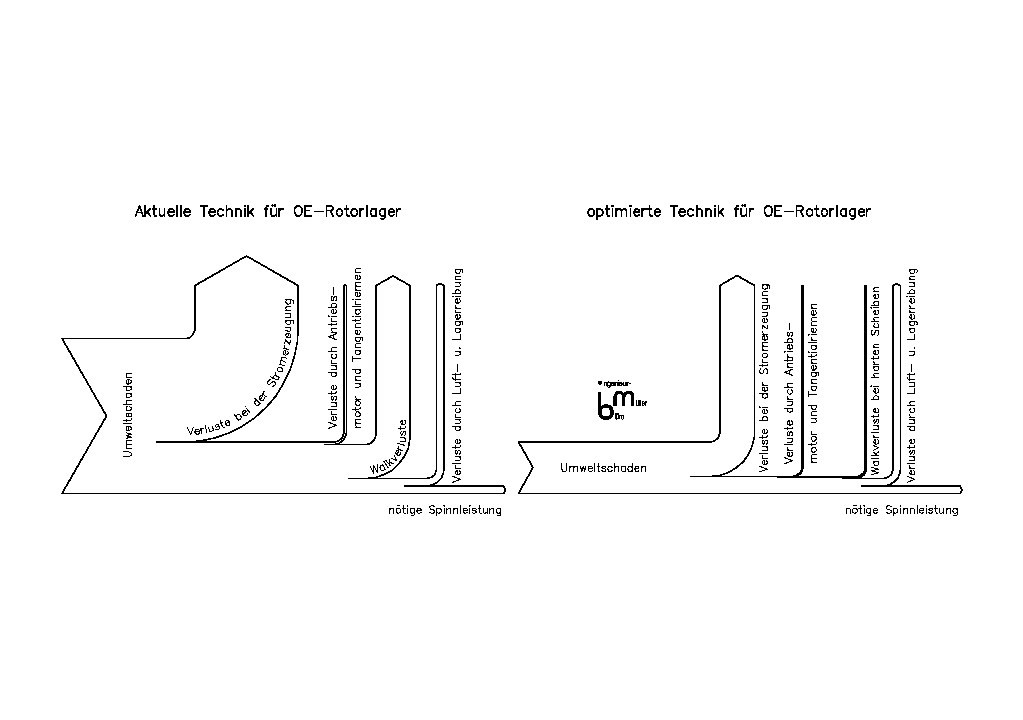
A OE-bearing running with about 180.000 rpm, consumpts about 150 Watt
to 200 Watts. How intensive measurements show, the very most of this
energy is
used to heat up the rubber of the supporting disks of the bearing. For
the
wished spinning process there are only max. 30 Watts left. The rest
heats
mainly up the damping rubber which rises up near to the limit
temperature. Therefore the bearing has to be cooled under big
difficulties which are consumpting
extra energy. The high power consumption leads to high danger of fire.
To
reduce this danger, a lot of air to cool the system ist to be used.
This
cooling costs extra energy.
The reason for the high power consumption of the bearing lies in the
high
damping wheels. They have to be used because of the bearings
kinematics. To
avoid the rotor to come frontwards, the axises of the four supporting
disks
are not parallel. So the rotor is screwed backwards by friction where a
axial
bearings stops the movement at an exact point.
If the bearing would be completely balanced, there wouldn't be no
further problems. But the unbalanced and high speed rotating masses
causes rotating forces. So the shaft pressing depends on the angle the
vector ist radial directet.
The force backwards is caused by friction. And the friction depends on
the
changing normal force. At the result the force backwards changes as
well.
And the geometry amplifies the forces backwards and a huge force
dynamic
is the result. This high dynamic leads to stimulate the very complex
spring
mass system to swing in a lot of frequencies. If there would be no
effective
damping in the supporting disks, the bearing couldn't run. But this
high
damping has its price: bad effectiveness, high energy costs to drive
the
system, high invenstition costs because of the complicated cooling and
heavy
motors, fire danger and a very loud noise.
Conventional OE-Bearings are so expensive because the damping
material (Vulcollan) ist very expensive, and the cooling and the heavy
motors with depending strong machine dimensions consumpting extra
money.
Proposal to solve the problem:
The weak and high damping wheels has to be eliminated. This efforts
geometric exactly defined relations how they are NOT found in nowoadays
OE-High-Speed-Bearings. The axises of the supporting wheels has to be
parallel. Now one have the problem
of the forwards coming shaft. To avoid this, one has to use wide
reaching
forces which can be realised with unfocused magnetic fields. But now
the
exact position of the shaft couldn't be realised. Therefore a short
distance
high grade force has to work against the "soft" force. How this could
run
I don't like to speak about here. But You can ask me. My aim is to find
a
partner to realise the idea.
Economy:
If the requirements are fullfilled, there is no reason not to run steel
on
steel. The driving power can be reduced by the damping. Per spinning
box
there should be a driving power of 50 Watts enough (180.000 rpm). If
you
calculate the energy costs and the high using time than the buying
argument
is surely very high. The proposed bearing allows to use the given
bearing
dimensions of existing machines. Than the bearings can be changed by
third
party deliverers very simply. If a manufactorer will join my proposal
then
the whole machine could be made much cheaper. Reasons: Smaller driving
motor,
weaker (cheaper) structure of the machine body. A further buying
argument
is the reduced driving power. Because of the reduced driving power
smaller
tangential belts are possible. Therefore the supporting disks can be
arranged
closer. The shaft can be shortened by this amount. The limit frequency
ist
rising and higher speed is possible with only a few development
efforts..
To do:
If You are interested in th development of this bearing, pleas don't
hesitate to contact me and let us work together.
Email: Christoph.Mueller@astrail.de
Flat Heatings, Calculating, Layouting
ASTROHS
Railtaxi (was Bahntaxi)
Environment (German language)
Back to Homepage